


 PDF Downloads:
204
PDF Downloads:
204


Introduction
Tomato (Solanum lycopersicum L.), a prominent vegetable crop in the Solanaceae family, is widely cultivated across many regions of the world and ranks second after potatoes in global production. It is a climacteric fruit characterized by a high respiration rate and high moisture content, which makes it highly perishable and susceptible to postharvest deterioration, diseases, continued ripening, and senescence.1-4 Significant losses occur during production, harvesting, handling, transportation, and storage, resulting in reduced fruit quality.5 Global postharvest losses of tomatoes range from 25–42%.6 Economic losses due to postharvest damage have been estimated at $446 million in Nigeria, $48.2 million in Rwanda and $206 million in Maharashtra (India),.7 Tomato quality is determined by physical attributes such as size, pericarp thickness, and colour, as well as chemical properties including pH, ascorbic acid, acidity, and total soluble solids (TSS).8 Fruit size strongly influences market value, while manual sorting is often inaccurate due to reliance on human judgment.
Physical properties of tomatoes are essential for designing equipment used in processing, sorting, separation, storage, and transportation.9-11 Lack of knowledge of these properties may lead to inefficient machine performance. Therefore, accurate information on physical properties is necessary for solving design problems and for developing machinery used in large-scale food processing systems.12 Colour and physical characteristics of tomato cultivars are also important for designing harvesting and post-harvesting machinery. Fruit firmness influences consumer acceptance, while the balance of TSS and acidity determines flavour. Vitamin C and mineral content contribute to nutritional quality, ripening, and storage life.13 Quality attributes such as titratable acidity, total soluble solids (TSS), ascorbic acid, and lycopene are widely used indicators of tomato fruit quality.14 In addition, respiration rate, weight loss, firmness, and ethylene production are key indicators of tomato senescence.15,16 The respiration rate plays a key role in determining fruit quality during storage; therefore, its accurate assessment is vital in food and postharvest research.17
Although several studies have reported the physical and chemical properties of tomatoes, most investigations have focused on general quality attributes without linking these properties to engineering design requirements for postharvest handling systems. In particular, limited information is available on the combined evaluation of physicochemical characteristics and respiration behaviour of commercially cultivated tomato varieties at different maturity stages under conditions relevant to storage and handling operations. Variations in fruit size, firmness, and respiration activity during ripening can significantly influence the design and efficiency of grading systems, packaging structures, and storage environments. Therefore, a systematic assessment of these parameters is necessary to provide quantitative data useful for the development and optimisation of postharvest equipment. In this context, the present study was undertaken to evaluate the physicochemical properties and respiration behaviour of two tomato cultivars (CV-613 and Naveen) at different maturity stages in order to generate engineering design information for improved postharvest handling, storage, and processing systems.
Materials and Methods
Popular tomato varieties cv. 613 and cv. Naveen were selected for this study due to their commercial significance and widespread cultivation in Tamil Nadu and Karnataka, respectively. Additionally, these cultivars exhibit distinct physicochemical and respiration characteristics, making them suitable for evaluating maturity-dependent changes. Fruits of cv. 613 at different maturity stages were procured from a local farmer (Rangaswamy Farm, Eachaikote), located about 50 km from NIFTEM-T, Thanjavur. The cv. Naveen tomatoes were obtained from Kolar district, Karnataka, harvested at different maturity stages and transported to the laboratory within 24 hours in plastic crates cushioned with newspaper. No visible transportation damage was observed. A representative sample of fruits used in the experiments is shown in Plate 1. Tomatoes exhibiting similar size, shape, and colour were chosen to maintain uniform experimental conditions. The fruits were rinsed thoroughly with running water to remove dust and debris, followed by draining to remove excess moisture before analysis.
Determination of Physical Properties of Tomatoes
Standard procedures proposed by Mohsenin18 were employed to assess the physical properties of the tomato samples. The experiments were carried out under controlled laboratory conditions, with temperature maintained at 30 ± 2 °C and relative humidity at 65 %. These conditions were monitored throughout the experimental period to ensure consistency.
Size (Diameter) and Surface Area
Thirty tomato fruits were selected for dimensional measurements using a dial caliper. The size of each fruit was recorded along three mutually perpendicular directions to obtain the major (L), intermediate (B), and minor (T) diameters. These values were then applied to calculate the geometric mean diameter (GMD) and surface area (S) using the equations provided below.
Size (GMD) = (L x B x T) 1/3
S = π (GMD) 2
Where L, B, and T are the major, intermediate, and minor diameters (mm), respectively, and S is the surface area (mm²).
Unit weight
The weight of thirty randomly selected fruits was measured with an electronic balance, and the mean value was computed to represent the unit fruit weight.
True Volume
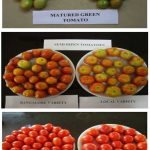 |
Plate 1: Tomato Fruits at Different Maturity Level used for the StudiesClick here to view Plate |
The water displacement method was employed to determine the actual volume of tomato fruits. Each fruit was weighed in air and then suspended in water using a sinker rod. The difference between the submerged reading and the weight of the container with water indicated the mass of displaced water. Based on this value, the true volume of the fruit was computed as:

True Density
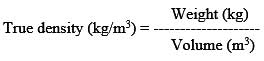
Fruit density was obtained by relating the weight of the fruit to its volume, and it was calculated using the following expression.
Color
The color of tomato samples was measured using a Hunter Color Meter (Model CR200b) (Plate 4). The instrument was calibrated using a white standard tile (X = 81.46, Y = 86.30, Z = 89.63). The color parameters of the samples were recorded in the L*, a*, and b* coordinate system. To account for surface variation, five readings were taken around the middle of each fruit and the average value was recorded.
Textural Properties
Puncture Test
Textural analysis of tomato samples was carried out using a Texture Analyzer (Stable Micro Systems Ltd., UK). The firmness of the fruit skin was measured by puncturing the surface with a 2 mm stainless steel probe (P2).The peak force required to puncture the skin was recorded as the puncture strength using Texture Expert Exceed software. The average value was calculated from five replicates.
Determination of Chemical Properties
Fresh tomato fruits at different maturity stages were evaluated for their chemical attributes using standard analytical techniques. The parameters measured were pH, moisture content, total soluble solids (TSS), titratable acidity, and ascorbic acid, as described in the subsequent sections.
Determination of moisture content
Moisture content of tomato samples was determined following the method described by AOAC19 for fruits and vegetables. Ten grams of sliced tomato sample was weighed using a digital balance and placed in a pre-weighed metal dish. The sample weight was measured initially and subsequently dried at 70 ± 1 °C for 24 h in a hot air oven. After drying, the dish was cooled in a desiccators and weighed. Drying of the sample was continued in successive 30 min periods until no further change in weight was observed. Moisture content on wet basis was calculated as:

Where, MC (wb) = Moisture Content, wet basis, %
W1 = empty container weight, g
W2 = weight of container plus fresh sample, g
W3 = weight of container plus dried sample, g
Measurements were conducted in triplicate and the average value was reported.
pH
A digital pH meter with a glass electrode was used to determine the pH of tomato juice, providing a direct indication of its acidic or alkaline nature.
Total soluble solids (TSS)
Total soluble solids were estimated using an Erma hand refractometer by placing a drop of tomato juice on the prism surface. The readings were taken directly, and the average of three measurements was calculated and expressed in °Brix.
Titratable acidity
The titratable acidity of tomato samples was determined by the visual titration method outlined by Ranganna.20 A 10 g portion of the sample was taken in a 100 mL beaker and mixed with distilled water. The mixture was heated for approximately one hour to extract the acids, followed by filtration through Whatman No. 4 filter paper. The obtained filtrate served as the sample solution for titration.
A 10 mL aliquot of this filtrate was titrated with 0.1 N sodium hydroxide solution using phenolphthalein as an indicator. The endpoint was identified by the development of a light pink color. The results were expressed as percentage of anhydrous citric acid.
Calculation

Ascorbic acid
The concentration of ascorbic acid was analyzed through the 2,6-dichlorophenol indophenol dye titration technique according to the method outlined by Ranganna.15
Preparation of dye solution
52 mg of 2, 6-dichlorophenol indophenol dye and 42 mg sodium bicarbonate were dissolved in 150 ml hot distilled water and the volume was made up to 200 ml.
Preparation of standard solution
4 % oxalic acid solution was prepared and used to dissolve L-ascorbic acid to obtain a standard solution containing 0.1 mg ascorbic acid per ml.
Standardization of dye
A solution containing 1 mL of standard ascorbic acid and 5 mL of 4% oxalic acid was titrated with the dye until a stable light pink colour persisted for about 5–10 seconds.
Dye factor = 0.1 / Titre value
Preparation of sample
The tomato sample (10 g) was extracted with 4% oxalic acid in a 100 mL volumetric flask and filtered to obtain the extract. A 10 mL portion of this filtrate was titrated with a standard dye solution. The endpoint was observed when a faint pink colour remained visible for 5–10 seconds.
Calculation

Determination of Respiration Rate
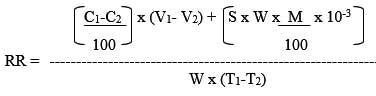
Tomato fruits from two cultivars, Naveen and 613, were evaluated for respiration rate at three developmental stages: mature green, semi-ripe, and fully ripe. Measurements were conducted at three storage temperatures (28, 20, and 12 °C) with corresponding relative humidity levels of 95%, 90%, and 65%, respectively, maintained under controlled conditions. Tomato fruits were placed in 3000 ml airtight glass jars and sealed using siliputin. The O₂ and CO₂ concentrations inside the jars, was measured using an PBI Dansensor CheckMate II. Gas composition was recorded immediately after sealing and subsequently at 1-hour intervals until the O₂ concentration dropped below 1%. The experimental procedures were repeated three times to ensure reliability of the results. The O2 or CO2 depletion curve obtained and by linear regression. For each experimental combination, the concentrations of O2 and CO2 were predicted at time intervals of 5 hours. The respiration rate of the fruits was calculated by using the following equation suggested by Nithya et al:.21
Where,
RR = Respiration rate (O2 consumption or CO2 release in ml kg-1hr-1)
C1 = Initial CO2 or O2 concentration %
C2 = Final CO2 or O2, concentration %
V1 – V2 = Difference of volume of the container and volume of fruit, ml
W = Fruit weight , kg
M = Moisture content in the fruit, ml
T1– T2 = Difference of initial period and final periods, h
S = Solubility of gases
Results
Physical Properties of Tomatoes
Information on fruit physical properties plays a crucial role in the design and development of equipment for harvesting, cleaning, handling, packaging, storage, and processing. Physical properties are necessary for design of equipment for harvesting, transporting, cleaning, packing, storing and processing of the fruits.22,23 The physical properties such as size, unit weight, volume, true density, firmness and color of the two varieties of tomatoes (cv.Naveen and cv.613) at three maturity stages: matured green, semi ripen and full ripen were measured. These properties has been important for growers, retailers and breeders-genetic researchers. Fruit grading done on size, colour, weight basis for market. Once graded tomatoes are packed in layers (pattern packed) cardboard boxes with a standard volume for export or transported long distance. Variety and maturity stages are plays vital role in sustaining damages. The weight, size, colour, and firmness of agricultural commodities are key parameters that help minimize losses during packaging and transportation. These characteristics are also important in designing equipment for product conveyance, cleaning and grading.24
The size and Surface area
The major, intermediate, and minor diameters represent the physical size of tomato fruits. The geometric mean diameter was calculated using the equation described and the measured values for both varieties are presented in Table 1. The geometric mean diameter of cv. Naveen ranged from 48.1 to 56.3 mm, while that of cv. 613 varied from 47.7 to 52.1 mm across different maturity stages. Statistical analysis showed that the effect of maturity stages and varieties on geometric mean diameter was highly significant (p ≤ 0.01). Both maturity stage and variety individually influenced the geometric mean diameter significantly (p ≤ 0.01), and the two cultivars also differed significantly from each other (p < 0.05). The surface area of cv. Naveen ranged from 7144 to 8540.6 mm², whereas that of cv. 613 varied from 7285.9 to 9966 mm² across the three maturity stages. Statistical analysis indicated that both variety and maturity stage had a significant effect (p < 0.05) on the surface area of tomato fruits, while their interaction effect was not significant (p < 0.05). Although the trend of increase in surface area with maturity was similar for both varieties, significant differences were observed between cultivars at each maturity stage.
Unit weight and Volume
The unit weight and volume of tomatoes at different maturity stages for cv. Naveen and cv. 613 is presented in Table 2. A slight difference in mean unit weight between the two varieties was observed; however, the variety effect was not significant. In contrast, maturity stage had a significant effect on unit weight. The highest weights (113 g and 114.8 g) were recorded at the fully ripe stage, while the lowest weights (91 g and 84.3 g) were observed at the mature green stage for cv. Naveen and cv. 613, respectively. The interaction between variety and maturity stage was not significant, as both varieties showed a similar trend of weight increase with maturity. These findings agree with those of Zhiguoi et al.,25 who reported no significant effect of cultivar on mass, volume, and bulk density in tomato varieties Fenguam906 and Jinguang28. The volume of fruits within the same variety varied significantly across maturity stages. The highest mean volumes (118 and 110 cm³) were recorded at the fully ripe stage, while the lowest volumes (107 and 106 cm³) were observed at the mature green stage for cv. Naveen and cv. 613, respectively. However, the effect of variety and the interaction between variety and maturity stage were not significant (p < 0.05), as both varieties showed a similar trend of volume increase with maturity.
Table 1: Diameter and Geometric Mean Diameter, Surface area of cv. Naveen and cv. 613 Tomatoes at Three Different Maturity Stages.
| Varieties | MS | Maior Dia,mm | Intermediate Dia,mm | Minor Dia, mm | Geometric mean Dia, mm | Surface Area (mm2) |
| cv.Naveen | MG | 52.6 ±1.69 | 51.7 ±1.52 | 46.1 ±0.14 | 48.1 ± 0.59 | 7285.9 ±427.1 |
| SR | 56.9 ±2.00 | 59.8 ±1.38 | 50.1 ±1.44 | 53.3 ±1.38 | 8907.0 ±117.9 | |
| FR | 61.9 ±0.61 | 62.0 ±1.92 | 52.7 ±1.38 | 56.3 ±0.45 | 9966.0 ±141.0 | |
| cv.613 | MG | 47.2 ±1.04 | 42.6 ±2.53 | 60.7 ±1.31 | 47.7 ±1.43 | 7144.0 ±176.5 |
| SR | 48.2 ±1.09 | 47.7 ±1.40 | 63.9 ±1.08 | 51.1 ±0.35 | 8223.1 ±445.6 | |
| FR | 49.5 ±0.56 | 50.6 ±1.00 | 65.8 ±0.91 | 52.1 ±0.40 | 8540.6 ±148.1 | |
| VarietiesCD (0.05) | ** | ** | ** | ** | ** | |
| 2.28 | 3.02 | 2.19 | 1.60 | 504.6 | ||
| Maturity StagesCD(0.05) | ** | ** | ** | ** | ** | |
| 2.80 | 3.69 | 2.68 | 1.96 | 618.1 | ||
|
Interaction Effect (VxM) CD(0.05)
|
NS | NS | * | NS | NS | |
| 3.95 | 5.22 | 3.79 | 2.78 | 874.1 | ||
MG: Matured green; SR: Semi ripen; FR: Full Ripen; **: Highly Significant; *: Significant; NS: Non Significant; CD: Critical Difference; -Mean value ±S.E are presented in Table
Table 2: Physical Characteristic of cv. Naveen and cv. 613 Tomatoes at Three Different Maturity Stages
| Varieties | Maturity stages | Unit weight (g) | Volume (cm3) | True density(kg m-3) | Firmness (N/mm) |
| cv. Naveen | MG | 091.0 ±1.81 | 107 ±2.08 | 0850 ± 0.02 | 5.40 ± 0.012 |
| SR | 103.3 ±7.37 | 110 ±2.89 | 0940 ±0.08 | 2.70 ±0.009 | |
| FR | 113.0 ±4.05 | 118 ±2.65 | 1000 ±0.05 | 1.45 ±0.006 | |
| cv.613 | MG | 084.3 ±1.54 | 106 ±5.04 | 0800 ±0.04 | 3.26 ±0.012 |
| SR | 111.7 ±2.62 | 109 ±5.57 | 1030 ±0.05 | 2.09 ±0.018 | |
| FR | 114.8 ±0.83 | 110 ±2.67 | 1040 ±0.02 | 1.28 ±0.017 | |
| VarietiesCD (0.05) | NS | NS | NS | ** | |
| 7.12713 | 3.0663 | 0.02545 | 0.02074 | ||
| Maturity StagesCD (0.05) | ** | * | ** | ** | |
| 8.72891 | 3.75543 | 0.06946 | 0.0254 | ||
| Interaction Effect (VxM)CD(0.05) | NS | NS | NS | ** | |
| 12.34455 | 5.31099 | 0.09823 | 0.03593 | ||
MG: Matured green; SR: Semi ripen; FR: Full Ripen; **: Highly Significant; *: Significant; NS: Non Significant; CD: Critical Difference; – Mean values ±S.E are presented in Table.
True density
The measured values of true density of tomato fruits at different maturity stages are presented in Table 2. The results indicated that true density varied significantly with maturity stage within each variety. Fully ripe tomatoes showed higher true density than unripe fruits. For instance, the true density of fully ripe fruits was 1040 kg m⁻³ for cv. 613 and 1000 kg m⁻³ for cv. Naveen, whereas at the mature green stage the values were 800 kg m⁻³ and 850 kg m⁻³, respectively. However, the effect of variety and the interaction between variety and maturity stage were not significant (p < 0.05), as both varieties exhibited a similar trend of density increase with maturity.
Firmness
The firmness values of tomatoes at different maturity stages for both varieties are presented in Table 2. The results showed that firmness differed significantly (p < 0.05) among maturity stages for both varieties, and their interaction effect was also significant. As expected, mature green tomatoes were firmer than fully ripe fruits. The highest firmness values were recorded in mature green fruits of cv. Naveen (5.4 N mm⁻¹) and cv. 613 (3.26 N mm⁻¹), followed by semi-ripe fruits (2.7 and 2.09 N mm⁻¹). The lowest firmness was observed in fully ripe fruits (1.45 and 1.28 N mm⁻¹), respectively.
Color value of tomatoes
Tomato color was assessed using the CIE L*, a*, and b* coordinates. The L* parameter represents lightness, ranging from black (0) to white (100). The a* value describes the green to red spectrum, while b* indicates the blue to yellow range. To evaluate color development during ripening, the a*/b* ratio was calculated and expressed as the red color index.26,27
At different maturity stages, the colour parameters (L*, a*, b*, and a*/b*) of the two tomato varieties exhibited significant differences (p < 0.05), as presented in Table 3. The values of L* ranged from 50.4 to 32.8 for cv. Naveen and 51.9 to 34.3 for cv. 613, indicating that fruits became darker as ripening progressed. Mature green fruits showed negative a* values, indicating greenness, which gradually shifted to positive values as ripening progressed and fruits turned red. The highest redness values (20.2 and 22.1) were observed in fully ripe fruits of both varieties.
Table 3: Mean Color Values of cv. Naveen and cv. 613 Tomato Varieties at Three Different Maturity Stages
| Varieties | Maturity stages | L* | a* | b* | a*/b* |
| cv. Naveen | MG | 50.4 ±0.20 | -05.8 ± 0.22 | 18.3 ±0.08 | -0.32 ± 0.013 |
| SR | 42.5 ±0.21 | 08.0 ±0.09 | 29.0 ±0.07 | 0.28 ±0.003 | |
| FR | 32.8 ±0.14 | 20.2 ±0.24 | 17.6 ±0.30 | 1.15 ±0.023 | |
|
cv.613 |
MG | 51.9 ±0.15 | -04.2 ±0.18 | 21.0 ±0.05 | -0.20 ±0.008 |
| SR | 43.6 ±0.89 | 08.3 ±0.27 | 32.3 ±0.12 | 0.26 ±0.009 | |
| FR | 34.3 ±0.35 | 22.1 ±0.05 | 16.7 ±0.13 | 1.32 ±0.011 | |
| VarietiesCD (0.05) | ** | ** | ** | ** | |
| 0.76 | 0.38 | 0.28 | 0.03 | ||
| Maturity StagesCD (0.05) | ** | ** | ** | ** | |
| 0.93 | 0.47 | 0.34 | 0.03 | ||
| Interaction Effect (VxM)CD (0.05) | NS | ** | ** | ** | |
| 1.31 | 0.66 | 0.48 | 0.05 | ||
MG: Matured green; SR: Semi ripen; FR: Full Ripen; **: Highly Significant; *: Significant; N S: Non Significant; CD: Critical Difference; – Mean values ±S.E are presented in Table
Table 4: Chemical Characteristic of cv. Naveen and cv. 613 Tomato Varieties at Different Maturity Stages
| Varieties | Maturity stages | Moisture content, w.b % | pH | TSS , oBrix | TitratableAcidity, % | Ascorbic Acid, mg/100g |
| cv. Naveen | MG | 93.7 ± 0.09 | 3.6 ±0.00 | 3.8 ±0.00 | 0.57 ±0.00 | 19.8 ± 0.07 |
| SR | 94.3 ±0.03 | 3.9 ±0.00 | 4.1 ±0.10 | 0.54 ±0.00 | 28.0 ± 0.28 | |
| FR | 94.1 ±0.04 | 4.1 ±0.01 | 5.2 ±0.06 | 0.48 ±0.01 | 34.1 ±0.14 | |
| cv.613 | MG | 93.2 ±0.04 | 3.7 ±0.01 | 3.6 ±0.01 | 0.56 ±0.01 | 21.5 ±0.26 |
| SR | 94.3 ±0.01 | 4.0 ±0.01 | 4.0 ±0.02 | 0.52 ±0.00 | 33.2 ±0.22 | |
| FR | 94.6 ±0.03 | 4.1 ±0.00 | 5.0 ±0.03 | 0.45 ±0.01 | 36.9 ±0.37 | |
| VarietiesCD (0.05) | NS | ** | ** | ** | ** | |
| 0.07972 | 0.00759 | 0.08655 | 0.0085 | 0.3128 | ||
| Maturity StagesCD (0.05) | ** | ** | ** | ** | ** | |
| 0.09763 | 0.0093 | 0.106 | 0.01042 | 0.3831 | ||
| Interaction Effect (VxM), CD (0.05) | ** | ** | NS | * | ** | |
| 0.13807 | 0.01315 | 0.14991 | 0.01473 | 0.54178 | ||
MG: Matured green; SR: Semi ripen; FR: Full Ripen **: Highly Significant; *: Significant NS: Non Significant CD: Critical Difference; – Mean values ±S.E are presented in Table
Chemical Properties of Tomatoes
Moisture content
The moisture content of tomatoes at different maturity stages for cv. Naveen and cv. 613 is presented in Table 4. The results indicated that moisture content varied significantly (p < 0.05) with maturity stage. The lowest moisture content was observed in mature green fruits (93.6% and 93.2% for cv. Naveen and cv. 613, respectively), followed by semi-ripe fruits (94.3% and 94.6%). The highest moisture content was recorded in fully ripe fruits (94.1% and 94.3%), which corroborates the results reported in previous studies reported by Nithya et al.21 The interaction effect between variety and maturity stage was also significant (p < 0.05). The results indicate that tomatoes become more watery as ripening progresses, with fully ripe fruits containing approximately 1–1.5% more moisture than mature green fruits. Additionally, the moisture content of the two varieties differed significantly (p < 0.05) at all maturity stages.
pH
Tomato is classified as an acid fruit vegetable (acid class I) with a pH range of 3.7–4.6 (Gould, 1978). The pH values of tomato fruits at different maturity stages for cv. Naveen and cv. 613 are presented in Table 4. The results revealed that pH varied significantly (p < 0.05) with the progression of ripening. The highest pH value (4.1) was observed in fully ripe fruits, followed by semi-ripe fruits (3.9 and 4.0) for the two varieties. which aligns with observations documented in earlier research reports by Nithya et al.,21 Moneruzzaman et al.,28 and Karki.29 The interaction effect between variety and maturity stage and the varietal differences were also significant (p < 0.05).
Total soluble solids (TSS)
The TSS values of both tomato varieties at three maturity stages differed significantly (p < 0.05) (Table 4). The highest TSS was observed in fully ripe fruits of cv. Naveen (5.2 °Brix) and cv. 613 (4.54 °Brix), followed by semi-ripe fruits (5.0 and 4.53 °Brix). The lowest TSS values were recorded in mature green fruits (4.66 and 4.33 °Brix). These findings are agreement with the results of previous reports by Moneruzzaman et al,28 Karki29 and Tigist et al.,30 who also observed significant variation in quality parameters among tomato cultivars.
Titratable Acidity
The titratable acidity of tomato pulp for different maturity stages of cv. Naveen and cv. 613 varied significantly (Table 4). In cv. Naveen, acidity ranged from 0.57 to 0.48%, while in cv. 613 it ranged from 0.57 to 0.45%. These values are comparable with those reported by Chippy et al.31 Similar observations were reported by Karki29 and Shehla and Tariq,32 confirming that acidity generally decreases as tomatoes progress from mature green to fully ripe stage.
Ascorbic acid
Vitamin C is an essential nutrient supplied mainly by fruits and vegetables, with L-ascorbic acid being its primary biologically active form. The ascorbic acid content of tomatoes varied significantly (p < 0.05) among maturity stages and varieties (Table 4). The highest values were observed in fully ripe fruits of cv. Naveen (34.10 mg/100 g) and cv. 613 (36.9 mg/100 g), followed by semi-ripe fruits (28.40 and 33.2 mg/100 g). The lowest levels were recorded in mature green fruits (19.8 and 21.5 mg/100 g). These results agree with Karki,29 Shehla and Tariq;32 Delina Felix and Mahendran.33
Respiration of Fresh Tomato Fruits
Respiration is a major metabolic process responsible for natural ripening, senescence, and eventual deterioration of fruits. It is also an important design factor in modified atmosphere packaging and storage systems. Therefore, respiration studies were conducted on freshly harvested tomatoes of two varieties (cv. Naveen and cv. 613) at three maturity stages-mature green, semi-ripe, and fully ripe-under storage temperatures of 28, 20, and 12°C, following the procedures described earlier.
The results showed that O₂ concentration decreased with time, falling below 1%, while CO₂ concentration increased from 0.03% to nearly 20%. The time required for these changes was longer at lower temperatures: about 72–80 h at 12°C, 40–50 h at 20°C, and 18–24 h at 28°C, depending on maturity stage. Gas concentration changes occurred more rapidly in fully ripe tomatoes at 28°C and more slowly in mature green tomatoes at 12°C for both varieties. The measured O₂ and CO₂ concentrations from three replicates were pooled and presented in Figure 1 for the mature green stage of cv. Naveen at 28°C. Similar trends were observed for cv. 613, and graphs for other experimental combinations are recorded and analysed.
The results indicated that the decline in O2 concentration followed an exponential relationship and could be represented by an empirical equation of the following form:

Likewise, the variation of CO2 concentration with time was represented using an empirical model expressed as follows.

The coefficient of determination (R²) was 0.99, indicating that the exponential model adequately described the changes in gas concentrations over time. Using the empirical models (Equations 1 and 2), Predictions of O2 and CO2 concentrations were predicted for all treatments from 0 to 60 h at every 3-hour interval. Based on these predicted values, respiration rates were calculated for each maturity stage and temperature. As shown in Figure 2, the respiration rate (CO₂ produced, ml kg⁻¹ h⁻¹) of mature green tomatoes (cv. Naveen) at 28°C decreased with decreasing O₂ concentration. A similar trend was observed across all maturity stages and temperatures, indicating that respiration rate were influenced by the O₂ and CO₂ concentrations within the airtight glass bottles. Temperature was identified as the most important external factor affecting respiration. Respiration rates at 28, 20, and 12°C differed significantly (p < 0.05). The variety cv. Naveen exhibited higher respiration rates than cv. 613 at all maturity stages. The highest respiration rate was recorded at 28°C, ranging from 98 to 60 ml kg⁻¹ h⁻¹ for cv. Naveen and 80 to 56 ml kg⁻¹ h⁻¹ for cv. 613. The lowest respiration rates were observed at 12°C, varying from 20.42 to 12.3 ml kg⁻¹ h⁻¹ for cv. Naveen and 17.5 to 11.3 ml kg⁻¹ h⁻¹ for cv. 613 (Table 5). Higher temperatures increased respiration and ethylene production, while lower temperatures reduced biochemical reactions in fruits.
Table 5: Respiration rate of fresh tomato fruits at different temperature
| Variety | Maturity Stages | Respiration Rate (CO2 produced ml kg-1hr-1) | ||
| 28oC | 20oC | 12oC | ||
| cv.Naveen | Matured Green (MG) | 60.66 | 28.98 | 12.3 |
| Semi ripen (SR) | 72.19 | 35.11 | 17.94 | |
| Full ripen (FR) | 98.96 | 44.01 | 20.42 | |
| cv.613 | Matured Green (MG) | 56.84 | 24.22 | 11.3 |
| Semi ripen (SR) | 64.22 | 33.68 | 15.64 | |
| Full ripen (FR) | 80.49 | 44.08 | 17.5 | |
| F test | ** | ** | ** | |
| V x M x T | SED CD(0.05) CD(0.01)0.06269 0.12745 0.17104 | |||
| Effect | V M T VxM MxT VxT | |||
| CD | 0.042 0.052 0.052 0.073 0.090 0.073 | |||
**Significant at 1% level, Mean values are presented in Table
Table 6: Respiration Rate and RQ values at 28oC at ambient air condition
| Variety | Maturity level | Initial conc.(O2) | Initial conc.(CO2) | RR (O2 consumed) | RR (CO2 produced) | RQ |
| cv.Naveen | Matured (Breaker) | 19.95 | 0.591 | 67.42 | 60.66 | 0.90 |
| Semi ripen ( Pink) | 19.31 | 0.428 | 73.51 | 72.19 | 0.98 | |
| Full ripen (Red) | 20.29 | 0.830 | 90.17 | 98.96 | 1.09 | |
| cv.613 | Matured (Breaker) | 21.24 | 0.653 | 53.05 | 56.84 | 1.07 |
| Semi ripen ( pink) | 20.18 | 0.500 | 65.93 | 64.22 | 0.97 | |
| Full ripen (Red) | 21.72 | 0.239 | 73.776 | 80.49 | 1.09 |
Table 7: Respiration Rate and RQ values at 20 oC at ambient air condition
| Variety | Maturity level | Initial conc (O2) | Initialconc (CO2) | RR (O2 consumed) | RR (CO2 produced) | RQ |
| cv.Naveen | Matured (Breaker) | 19.21 | 1.564 | 30.96 | 28.98 | 0.94 |
| Semi ripen( pink) | 18.54 | 0.165 | 32.34 | 35.12 | 1.08 | |
| Full ripen(Red) | 19.06 | 1.523 | 54.46 | 40.25 | 0.73 | |
| cv.613 | Matured (Breaker) | 18.97 | 1.717 | 25.54 | 25.22 | 0.95 |
| Semi ripen( pink) | 19.57 | 1.00 | 32.05 | 33.68 | 1.05 | |
| Full ripen(Red) | 21.19 | 0.723 | 47.90 | 44.02 | 0.92 |
Table 8: Respiration Rate and RQ values at 12 oC at ambient air condition
| Variety | Maturity level | Initial conc (O2) | Initial conc. (CO2) | RR (O2 consumed) | RR (CO2 produced) | RQ |
| cv.Naveen | Matured (Breaker) | 20.65 | 0.31 | 12.28 | 11.30 | 0.92 |
| Semi ripen (pink) | 20.43 | 0.08 | 14.77 | 15.64 | 1.05 | |
| Full ripen (Red) | 19.38 | 0.23 | 19.63 | 17.50 | 0.89 | |
| cv.613 | Matured (Breaker) | 20.69 | 0.14 | 14.02 | 12.30 | 0.87 |
| Semi ripen ( pink) | 19.65 | 0.79 | 17.29 | 17.94 | 1.03 | |
| Full ripen (Red) | 19.50 | 1.06 | 22.17 | 20.420 | 0.92 |
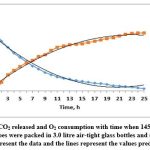 |
Figure 1: The CO2 released and O2 consumption with time when 1450 g of green cv. Naveen tomatoes were packed in 3.0 litre air-tight glass bottles and stored at 28°C. Symbols represent the data and the lines represent the values predicted values. Click here to view Figure |
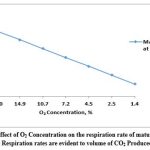 |
Figure 2: The Effect of O2 Concentration on the respiration rate of matured tomatoes of cv.Naveen. The Respiration rates are evident to volume of CO2 Produced as ml kg-1 hr-1)Click here to view Figure |
Discussion
Physical Properties of Tomatoes
Tomato fruits of cultivar Naveen were generally larger than those of cultivar 613. Comparable differences in fruit size among tomato cultivars have also been reported by Zhiguo Li et al25 and Amin Taheri et al.34 Indicating that cultivar characteristics strongly influence fruit dimensions. Although the maturity stage significantly influenced fruit size, the interaction between cultivar and maturity stage was not statistically significant. The geometric mean diameter increased progressively with fruit maturity, and this trend was similar for both cultivars. Similar results were reported by Mahmoud et al.13 Fruit size is an important factor in the design of hoppers, grading equipment, machine openings, and packaging systems, as proper design helps minimize mechanical losses during handling and transportation.
Surface area is another important parameter for the development of sorting and grading equipment, especially in automated systems where accurate classification based on fruit size is required. Automated systems improve precision and consistency compared with manual sorting, which is often affected by labour fatigue and limited accuracy.
Unit weight is a key parameter in designing conveying systems, handling equipment, and machine components such as slicing discs, cutting blades, and sample holders. It is also important for hydrodynamic transport systems used in fruit processing. The results further showed that unripe fruits possess lower volume compared with fully ripe fruits. From a practical perspective, transporting mature green tomatoes for long distances can be advantageous because they occupy less space and are less prone to mechanical injury during handling.
Transporting unripe tomatoes over long distances may also be economically beneficial because more fruits can be stacked within a given volume compared to fully ripe tomatoes. In addition, mature green fruits exhibit greater firmness, which reduces the likelihood of bruising and mechanical damage during transport and allows stacking at higher levels. Firmness is closely associated with fruit quality, consumer acceptance, and market value. During ripening, tomatoes undergo textural softening due to enzymatic degradation of cell wall components, which reduces shelf life and increases susceptibility to mechanical damage during postharvest handling and transportation (Shehata et al;35 Md. Safiuddin Bapary et al.,36). Therefore, firmness is a critical parameter in determining the postharvest quality and marketability of tomato fruits.
The a*/b* ratio increased as ripening progressed, indicating enhanced development of red colour during maturation. Similar trends have been reported by Ait-Oubahou,37 Ali Batu38 and Arazuri et al.39
Chemical Properties of Tomatoes
The results suggest that tomato fruits become more succulent as ripening advances, with fully ripe fruits containing approximately 1–1.5 % higher moisture than mature green fruits. Significant differences in moisture content between the two cultivars were observed at all maturity stages (p < 0.05).
pH is an essential factor in the fruit processing industry because tomato cultivars with higher pH values generally exhibit lower acidity and reduced microbial stability, making them less suitable for processing applications. The increase in total soluble solids (TSS) during ripening may be attributed to the conversion of complex carbohydrates into simple sugars, resulting in higher soluble solid content, as also reported by Bhuvanaswri.8
The results also indicated a gradual decline in titratable acidity with increasing fruit maturity. This decrease during ripening may result from metabolic conversion, translocation, and utilization of organic acids as substrates in respiration processes Dubey and Gaur.40 Furthermore, higher vitamin C content contributes to improved nutritional quality and helps maintain colour stability in tomato products.
Respiration of Fresh Tomatoes
Under ambient conditions (approximately 21 % O2), respiration rates were higher, leading to increased release of CO2. Similar observations were reported by Nithya et al.16 for mature green tomatoes. Thompson41 also reported that CO2 evolution and O2 consumption tend to decrease with storage duration, with more pronounced effects at higher oxygen concentrations.
Significant differences in respiration rate were observed between the two cultivars, Naveen and 613 (p < 0.05). Differences were also evident among the maturity stages within each cultivar. Since tomato is a climacteric fruit, metabolic activity increases during the ripening phase, resulting in elevated respiration rates.
Respiration rates are also strongly influenced by temperature, and they typically double with every 10 °C increase in temperature, as reported by Burzo42 and Kader et al.43 The respiratory quotient values observed in this study ranged from 0.7 to 1.0, which agrees with previously reported values for tomatoes.
The results further indicate that mature green tomatoes stored at approximately 12 °C exhibit the lowest respiration rates and consequently a longer storage life.
Engineering Design Implications for Postharvest Handling Systems
The measured physicochemical properties of tomato fruits provide useful engineering parameters for the design of harvesting, grading, packaging, and storage systems. The geometric mean diameter of the studied cultivars ranged from 47.7 to 56.3 mm, indicating that grading equipment and sorting apertures should be designed to accommodate fruits within this size range. Similarly, the surface area values (7144–9966 mm²) are useful in estimating heat and mass transfer during storage and modified atmosphere packaging.
The unit weight of tomatoes varied from 84.3 to 114.8 g, which provides important information for designing conveying and handling equipment. The firmness values decreased from 5.4 N mm⁻¹ in mature green fruits to about 1.28 N mm⁻¹ in fully ripe fruits, suggesting that handling systems should apply lower mechanical forces when transporting ripe tomatoes to avoid bruising and mechanical damage.
Respiration studies showed that the respiration rate increased with temperature and maturity stage. The highest respiration rate was observed at 28°C, while the lowest rate occurred at 12°C. These findings indicate that storage systems should maintain temperatures close to 12°C to reduce metabolic activity and extend shelf life. The measured respiration rates (11–99 ml CO₂ kg⁻¹ h⁻¹) can be used to estimate ventilation requirements and gas exchange rates in modified atmosphere packaging systems.
Overall, the generated database of physical, chemical, and respiration properties provides useful design parameters for developing efficient grading equipment, packaging systems, and storage facilities for fresh tomatoes.
Conclusion
The present study investigated the physicochemical properties and respiration behavior of two tomato cultivars (CV-613 and Naveen) at different maturity stages. Significant variations in physical properties such as fruit surface area, size, weight, firmness, and density were observed with advancing maturity. Fruit dimensions and surface area increased during ripening, while firmness decreased markedly from the mature green to the fully ripe stage. Chemical properties, including pH, total soluble solids (TSS), and ascorbic acid, increased with ripening, whereas titratable acidity decreased. Respiration studies revealed that the respiration rate increased with both maturity stage and temperature, with the highest rates observed at 28 °C and the lowest at 12 °C. Storage at approximately 12 °C can therefore help reduce respiration activity and extend tomato shelf life. The physicochemical and respiration data generated in this study provide useful engineering parameters for the design and optimization of grading equipment, packaging systems, and modified atmosphere storage, thereby improving postharvest handling and reducing losses in tomato supply chains. While the present study provides important insights into selected cultivars, future research involving a wider range of cultivars is recommended to enhance the robustness and broader applicability of the findings.
Acknowledgement
The authors sincerely acknowledge the support and necessary research facilities provided by National Institute of Food Technology, Entrepreneurship and Management –Thanjavur (NIFTEM-T), Tamil Nadu, India.
Funding Sources
The authors gratefully acknowledge the financial support received in the form of Senior Research Fellowship (SRF-142185/2K10/1) from the Council of Scientific and Industrial Research (CSIR), Government of India, for carrying out the Ph.D research work.
Conflict of Interest
The authors do not have any conflict of interest.
Data Availability Statement
The manuscript incorporates all datasets produced or examined throughout this research study. The data that support the findings of this study are available from the corresponding author upon reasonable request.
Ethics Statement
This research did not involve human participants, animal subjects, or any material that requires ethical approval.
Informed Consent Statement
This study did not involve human participants, and therefore, informed consent was not required.
Permission to reproduce material from other sources
Not Applicable
Author Contributions
Sadvatha Ramanna Haromuchadi: Conceptualization, Methodology, Investigation, Data curation, Formal analysis, Writing – original draft preparation.
Karuppiah Alagusundaram: Supervision, Validation, Writing – review and editing.
References
- David J Chalmers, Kingsley S Rowan. The Climacteric in Ripening Tomato Fruit. Plant Physiol. 1971; Sep 48(3):235–240. doi: 1104/pp.48.3.235
CrossRef - Biale, J.B., Young, R.E. Respiration and ripening in fruits retrospect and prospect. In: Friend, J., Rhodes, M.J. (Eds.), Recent Advances in the Biochemistry of Fruits and Vegetables. Academic Press, New York, 1981; 1–40
- Andrews J.The climacteric respiration rise in attached and detached tomato fruit. Post harvest Biology and Technology. 1995; 6:287-292.
CrossRef - Reham S. Bakry1, El-Sayed G. Khater, Adel H. Bahnasawy And Samir A. Ali. Effect of Drying Methods on the Quality of Dried Tomatoes. MISR Journal of Agricultural Engineering, 2021; 38 (2): 155 – 180.
- Wael Abou El-Magd Mahmoud, Ragab Kassem Mahmoud and, Ahmed Salah Eissa., Determining of some physical and mechanical properties for designing tomato fruits cutting machine. AgricEngInt: CIGR Journal Open access. 2022; 24 (4), 131-142.
- Arah I.K. , H. Amaglo, E.K. Kumah, H. Ofori. Preharvest and postharvest factors affecting the quality and shelf life of harvested tomatoes: A mini review. International Journal of Agronomy.2015; 1-6.
CrossRef - Kitinoja, L.O. Odeyemi, N. Dubey, S. Musanase, G.S. Gill. Commodity system assessment studies on the postharvest handling and marketing of tomatoes in Nigeria, Rwanda and Maharashtra, India. Journal of Horticulture and Postharvest Research. 2019; 2 (Special Issue-Postharvest Losses) 1-14
- Bhuvanaswri, P., Geethalakshmi, V., Ragavan, T., Krishnamoorthy, V. and Sivakumar T. Impact of planting window and N levels on tomato productivity and quality. The Pharma Innovation Journal. 2018;7(5): 327-330.
CrossRef - Arazuri, S., Jare´n, C., Arana, J.I and Pe´rez de Ciriza, J.J., 2007, Influence of mechanical harvest on the physical properties of processing tomato (Lycopersicon esculentum), Journal of Food Engineering, 80:190–198.
CrossRef - Waziri, A.N. and Mittal, J.P., 1983, Design related physical properties of selected agricultural products. AMA, 14(1): 59-62.
- Felix Uba, Eric Osei Esandoh , Donatus Zogho and Eric Gyimah Anokye. Physical and mechanical properties of locally cultivated tomatoes in Sunyani, Ghana. Scientific African. 2020; 10:1-12.
CrossRef - Abd-Elhay, Y. B. Determination of some physical and mechanical properties of potato tubers related to design of sorting, cleaning, and grading machine. Misr Journal of Agricultural Engineering, 2017; 34(3):1375-1388.
CrossRef - Mahomud, M. S., Islam, M. N., & Roy, J. Effect of low oxygen stress on the metabolic responses of tomato fruit cells. 2024;10(3):e24566.
CrossRef - Aboutalebi A, Hasanzadeh Khankahdani H, Zakeri E. Study on Yield and Quality of 16 Tomato Cultivars in South of Iran. International Research Journal of Applied and Basic Sciences. 2012; 3:838-841.
- Maharaj Rohanie, Joseph Arul , Paul Nadeau . Effect of photochemical treatment in the preservation of fresh tomato (Lycopersicon esculentum Capello) by delaying senescence. Postharvest Biology and Technology. 1999; 15(1):13-23.
CrossRef - Meir Shimon, LimorRubin, Giora Zauberman, Yoram ,Changes in fluorescent lipid peroxidation products of room-ripened and vine-ripened tomato fruits in relation to other ripening parameters.Postharvest Biology and Technology. 1992; 2 (2): 125-135.
CrossRef - Wareham Peter D.and Krishna C. On-line analysis of sample atmospheres using membrane inlet mass spectrometry as a method of monitoring vegetable respiration rate. Analytica chimica acta. 1999; 394 (1):43-54.
CrossRef - Mohsenin N.,1986, Physical Properties of Plant and Animal Materials: Structure, Physical Characteristics, and Mechanical Properties. New York: Gordon and Breach Science.
- Chapter 37: Fruits and Fruit Products. In : Official Methods of Analysis of AOAC InternationaI, 16th Ed., Vol. 1: Agricultural Chemicals; Contaminants; Drugs. Association of Official Analytical Chemists International, Arlington, Virginia, USA. 1995; 5.
- Ranganna, S., Manual of Analysis of Fruit and Vegetable Products. 2nd, Tata Mc-Graw-Hill Pub. Com. Ltd., New Delhi. 1995,
- Nithya, D.J., Alagusundaram, K and Kavitha Abirami, C.V. Influence of storage temperatures, O2 concentrations and variety on respiration of tomatoes. Middle- east journal of scientific research, 2011; 7 (2): 194-202.
- Kabas,O., Ozemerzi, A and Akinci, I. Physical properties of cactus pear grown wild in Turkey. Journal of Food engineering, 2006;73 (2):198-202.
CrossRef - Kilickan A., and M. Guner. Physical properties and mechanical behaviour of olive fruits under compression loading, Food Eng. 2008;87 (2) : 222–228
CrossRef - Geasa , M.M.M and M.H.A.Hassan. Effect of Mechanical Damage on Tomato Fruits under Storage Conditions. of Soil Sciences and Agricultural Engineering, Mansoura Univ.2022; 13 (3):93–98.
CrossRef
- Zhiguoi Li, Pingping Li and Jizhan Liu. Physical and mechanical properties of tomato fruits as related to robot’s harvesting. Journal of Food Engineering. 2011; 103:170–178.
CrossRef - Ali batu. Determination of acceptable firmness and colour values of tomatoes. Journal of Food Engg. 2004; 61:471-475.
CrossRef - Bhowmik, S.R. and Pan, J.C. Shelf life of mature green tomatoes stored in controlled atmosphere and high humidity. Journal of Food Science. 1992; 57 (4): 948-953.
CrossRef - Moneruzzaman, K.M., Hossain, A.B.M.S., Sani, W and Saifuddin, M. Effect of Stages of Maturity and Ripening Conditions on the Biochemical Characteristics of Tomato. American Journal of Biochemistry and Biotechnology. 2008; 4 (4): 336-344. ISSN 1553-3468.
CrossRef - Karki, D.B. Effect of Harvesting states on the quality of tomato (Lycopersicaon esculentum mill CV. Avinash-2, hybrid), Tribhuvan University Journal. 2004; 25(1):145.
CrossRef - Tigist M, Workneh TS, Woldetsadik K. Effects of variety on the quality of tomato stored under ambient conditions J Food Sci Technol; 2011; 50(3):477-486.
CrossRef - Chippy AK, Beena Thomas, Rahana SN and Amrutha Unni M. Determination of fruit quality parameters of ten tomato (Solanum lycopersicum) genotypes and their Hybrids, Journal of Pharmacognosy and Phytochemistry. 2021; 10(1): 1621-1624.
CrossRef - Shehla Sammi and Tariq Masud. Effect of different packaging systems on storage life and quality of tomato (Lycopersicon esculentum var, Rio grande) during ripening stages. Internet Journel of Food Safety. 2007; 09: 37- 44.
- Delina Felix, E and Mahendran, T. Physico-chemical properties of mature green tomatoes (lycopersicon esculentum) coated with pectin during storage and ripening, Tropical Agricultural Research & Extension, 2008: 12:2.
CrossRef - Amin Taheri Garavand., Shahin Rafiee and Alireza Keyhani. Study on some morphological and physical characteristics of tomato used in mass models to characterize best post harvesting options. Australian Journel of Crop Science. 2011; 5(4):433-438.
- Shehata, S. A., Abdelrahman, S. Z., Megahed, M. M. A., Abdeldaym, E. A., El-Mogy, M. M., and Abdelgawad, K. F. Extending shelf life and maintaining quality of tomato fruit by calcium chloride, hydrogen peroxide, chitosan, and ozonated water. Horticulturae, 2021;7(9).
CrossRef - Safiuddin Bapary, Md. Nahidul Islam, Nikhil Kumer, Mahmudul Hasan Tahery, Mohammad Abdulla Al Noman, Mohammed Mohi-Ud-Din. Postharvest physicochemical and nutritional properties of Tomato fruit at different maturity stages affected by physical impact. Applied Food Research. 2024; 4: 1-11.
CrossRef - Ait-Oubahou, A. Modified atmosphere packaging of tomato fruit. In: Gerasopoulos D.(ed.).Post harvest losses of perishable horticultural products in the Mediterranean region. Chania: CIHEAM, 1999; 42:103-113.
- Ali batu. Determination of acceptable firmness and colour values of tomatoes. Journal of Food Engg. 2004; 61:471-475.
CrossRef - Arazuri, S., Jare´n, C., Arana, J.I and Pe´rez de Ciriza, J.J. Influence of mechanical harvest on the physical properties of processing tomato (Lycopersicon esculentum), Journal of Food Engineering. 2007; 80:190–198.
CrossRef - Dubey, A.K and Gaur, G. S.Biochemical Studies of four strains of Kakrol. Sci., 1990; 17(1):31-37
- Thompson, A.K.,Post harvest Technology of Fruit and Vegetables. Plast. Film & Sheet. 1996;1: 215.
- Burzo, I. Influence of temperature level on respiratory intensity in the main vegetables varieties. Acta Horticulture. 1980; 116: 61-64.
CrossRef - Kader A A, Zagory D and Kerbel E L. Modified Atmosphere Packaging for Fruits and Vegetables. Critical Review in Food Science and Nutrition. 1989; 28: 1–30.
CrossRef
Abbreviations
RR – Respiration Rate
TSS – Total Soluble Solids
PLW – Physiological Loss in Weight
MAP – Modified Atmosphere Packaging
MG – Mature Green Stage
BR – Breaker Stage
RR – Red Ripe Stage
L* – Lightness
a*/b* – Ratio of redness to yellowness (+ a*- Redness, – a*- Greenness, + b*- yellowness)